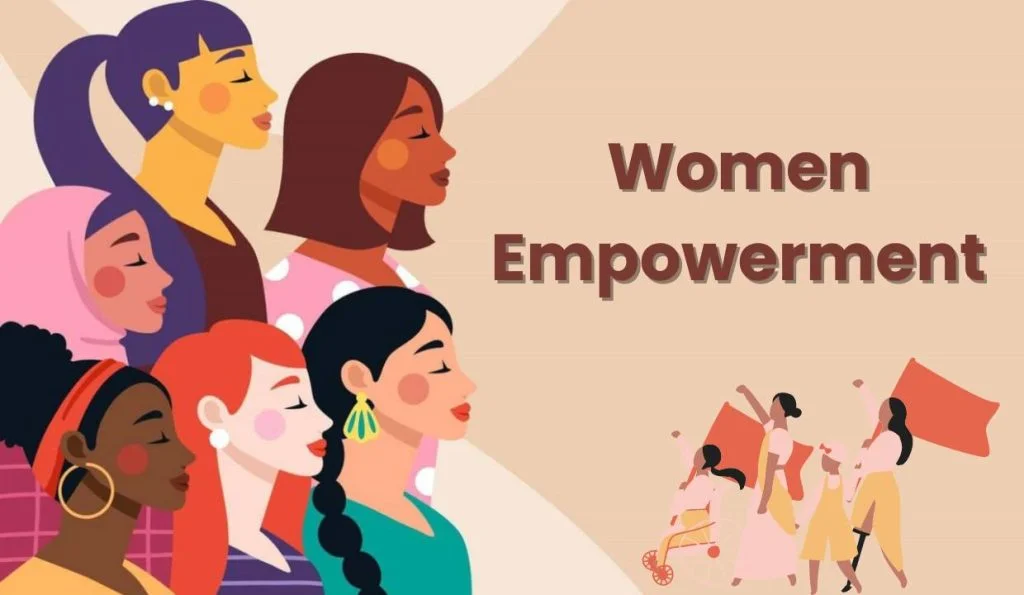
A Different Kind of Morning 🌅
Meena wakes up at 5 AM. She lights the stove, makes chai, packs tiffins, gets the children ready, drops them to school, then walks 2 kilometres to her job at a small tailoring unit. She earns Rs. 4,500 a month. She manages the household budget, pays the electricity bill, remembers every school exam date, and still finds time to help her neighbour's daughter with studies.
By the world's measurement — Meena is not 'empowered.' No big job title. No Instagram following. She has never attended a women's leadership conference.
But Meena runs an entire world. Every single day. Quietly. Without applause.
So when we talk about Women Empowerment — the real question is: Are we trying to empower women? Or are we finally trying to see the power they already carry?
This blog is about changing that perspective. Not just for society — but for women themselves.
Part 1: What Does 'Women Empowerment' Actually Mean? 🤔
The Old Meaning — And Why It Was Incomplete
For decades, Women Empowerment was defined very narrowly: Give a woman a job. Teach her to read. Let her vote. Give her some money. And then call her empowered.
This definition had a deep problem. It assumed women were empty vessels needing to be filled by society's generosity. It treated empowerment as something done TO women — not something that comes FROM within them.
It also created a hierarchy: educated, urban, working women were 'empowered' — while rural women, homemakers, and daily wage workers were seen as 'needing to be saved.'
"Empowerment is not a certificate society gives to women. It is the right every woman already has — and the world's job is to stop blocking it."
The New Perspective — Power Was Always There
The changing perspective starts with one radical shift: Women are not weak people who need to become strong. They are strong people who have been systematically told they are weak.
Every woman who raises children in difficult circumstances is a manager, psychologist, teacher, and planner. Every woman who runs a household on a tight budget is a finance expert. Every woman who protects herself and her children in an unsafe environment is a strategist and a survivor.
True empowerment is not about giving women strength. It is about removing the barriers — social, economic, legal, cultural — that have always stopped women from expressing the strength they already have.
Part 2: The Barriers That Still Exist — Let Us Be Honest 💔
- The Home — Where It All Begins and Often Ends
The first place a girl learns her place in the world is her home. If she sees her mother always asking permission — to go out, to spend money, to meet friends — she learns that women need permission. If she sees her brother getting more food, more education, more freedom — she learns that boys matter more.
- In many Indian homes, a girl's education is still seen as secondary to a boy's — especially when money is limited.
- Girls are often pulled out of school earlier to help at home or because 'she will go to her husband's house anyway.'
- Girls are taught to speak less, eat after others, adjust, sacrifice, and never ask for too much.
"We teach girls to shrink. Then we wonder why they do not take up space."
- Marriage — Where Dreams Often Get Paused
In India, marriage is still the most significant turning point in a woman's life — far more than for a man. A man's career continues after marriage. A woman's career is often expected to pause, adjust, or end entirely.
She moves to a new city, a new family, a new set of rules. Her identity changes — from daughter to daughter-in-law, from individual to wife and mother. And somewhere in this transition, the question 'But what does SHE want?' is rarely asked.
- The Workplace — Different Rules for the Same Game
Women who do enter the workforce quickly discover that the rules are different. They are paid less for the same work. They are passed over for promotions. They are expected to be soft-spoken — but criticized for not being assertive enough.
- India ranks 127th out of 146 countries in the Global Gender Gap Index (2024).
- Women make up only 20% of India's formal workforce — despite being 48% of the population.
- Women in India earn approximately 19% less than men for the same work.
"A woman has to work twice as hard to be seen as half as capable. And still she shows up, every single day."
- Safety — The Freedom That Was Never Free
The most fundamental barrier is one rarely included in policy discussions: safety. A woman who does not feel safe cannot be free. Women modify their entire lives around safety — what to wear, which route to take, when to come home, whether to take a night shift. Every one of these decisions shrinks a woman's world.
Empowerment cannot happen in a cage — even a well-decorated one.
Part 3: The Changing Picture — What Is Different Today 🌱
Women Are Rewriting the Story — In Every Field
- Kalpana Chawla became India's first woman in space — her story still inspires millions of girls in small towns.
- Self-Help Groups (SHGs) across rural India have given millions of women financial independence, confidence, and collective voice.
- Women panchayat leaders are now making real decisions, demanding accountability, and changing local governance.
- Young women from tier-2 and tier-3 cities are becoming YouTubers, coders, entrepreneurs, and athletes — using mobile phones to cross boundaries their mothers could not.
The Shift in Thinking — Men Are Part of This Too
One of the most important changes in the new perspective: this is not a women's issue — it is a human issue. A society where women are held back is a society where everyone loses.
When a woman is educated, her children are more likely to be healthy and educated. When a woman earns, more of that income goes back into the family. Empowering women is not charity — it is the single most powerful investment any family, community, or nation can make.
Men have a role: at home — share chores, don't control, listen. At work — be fair, speak up for female colleagues, don't take credit for women's ideas. In public — don't stare, don't judge, don't dismiss.
"Women's empowerment does not mean men lose something. It means everyone gains a fairer world."
Part 4: The New Faces of Empowerment 💜
It Is Not Just About Career — It Is About Choice
True empowerment is about choice — the freedom to choose one's own path without shame, pressure, or punishment.
A woman who chooses to be a homemaker — fully, joyfully, on her own terms — is just as empowered as a woman CEO. The difference is choice. Empowerment is when both options are genuinely available and equally respected.
A woman who chooses to marry at 30 rather than 20 is empowered. A woman who chooses not to marry at all is empowered. The key word — always — is CHOICE.
Rural Women — The Most Underestimated Force in India
The most powerful and most overlooked story of women's empowerment in India is happening not in corporate offices in Mumbai — but in villages across Rajasthan, Bihar, UP, MP, and Odisha.
Women farmers who manage entire agricultural cycles. Women in SHGs who built micro-enterprises from nothing. ASHA workers who walk kilometres every day to keep communities healthy. These women are empowered — not because society gave them permission, but because necessity, courage, and community gave them no other choice. They deserve to be seen and celebrated — not pitied.
"The most powerful women in India are often the ones nobody photographs for a magazine cover."
Part 5: What Needs to Change — From Every Direction 🛠️
In Families:
- Treat daughters and sons equally — same food, same education, same freedom, same dreams.
- Let girls speak, disagree, and have opinions at the dinner table.
- Teach boys to cook, clean, and care — these are human skills, not women's duties.
- Ask your daughter 'What do YOU want?' — and actually wait for the answer.
- When she gets married — do not erase her identity. Keep her connected to her education, interests, and friendships.
In Schools and Colleges:
- Teach girls about their legal rights — property rights, workplace rights, right to say no.
- Include women's achievements in textbooks — scientists, economists, athletes, and activists, not just historical queens.
- Create safe spaces for girls to report harassment without fear.
- Encourage girls to choose STEM, sports, arts — any field they choose.
In Workplaces:
- Pay women equally. Audit your pay structure.
- Implement the POSH Act genuinely — not just on paper.
- Offer flexible working for parents — not just mothers.
- Promote women to leadership roles based on merit, not tokenism.
What to Demand from the Government:
- Strict enforcement of equal pay laws and POSH Act across all sectors.
- Safe public transport, well-lit streets, and fast-track courts for crimes against women.
- Financial literacy programs for women in rural and semi-urban areas.
- Stronger implementation of property and inheritance rights for women.
Part 6: What Women Can Do — For Themselves 💪
- Know your rights. Property rights, domestic violence protection, equal pay, maternity leave — learn them.
- Build financial independence — even if small. A bank account in your name. A small saving. A skill that earns.
- Build your community. Find women who uplift you. Community is power.
- Stop apologizing for taking up space, having opinions, being ambitious, saying no.
- Support other women. Do not compete with them. A woman who lifts another woman multiplies her own power.
"When a woman knows her worth — she stops giving discounts to people who do not deserve her time."
Part 7: Stories of Real Power 🌟
The Woman Who Changed Her Village
Savitri Devi from a small village in Rajasthan never went to school. She was married at 16. But when a local NGO offered a literacy programme, she joined — and learned to read at 38. She then helped 40 women get NREGA job cards. She stood for the local panchayat election — and won. Today she has ensured clean water for 3 villages, built a girls' toilet in the primary school, and is fighting for a road pending for 20 years.
She never called herself empowered. She just saw a problem and fixed it.
The Daughter Who Said No — Respectfully
Priya, 24, from Lucknow, was asked to leave her job after marriage. She sat her in-laws down, showed them her monthly contribution to household expenses, and proposed a schedule where she could continue working while home responsibilities were shared. She did not fight. She did not run away. She presented a case — calmly, clearly, with facts. Her in-laws agreed. Two years later, her husband proudly tells people that his wife's income helped them buy their own flat.
"Empowerment is not always loud. Sometimes it is a quiet, firm conversation at the dinner table."
Resources and Support 📞
- National Commission for Women — ncw.nic.in — complaints and legal support
- Women Helpline — 181 (free, 24/7, all states)
- iCall Mental Health Helpline — 9152987821
- PM Mudra Yojana — low-interest business loans for women entrepreneurs
- Beti Bachao Beti Padhao — betibachaobetipadhao.nic.in
- One Stop Centres (Sakhi Centres) — support for women facing violence, legal issues, medical help
In the End — She Was Never Powerless 🤝
Women's empowerment is not a favour. It is not a project. It is not a slogan.
It is the recognition of a simple truth: Women are full human beings — with minds, ambitions, desires, rights, and an enormous capacity to lead, create, and transform.
The changing perspective is this: Stop asking 'How do we empower women?' Start asking 'What are we doing that stops women from expressing the power they already have — and how do we get out of the way?'
Because Meena — who woke up at 5 AM, ran an entire world, and still smiled — was never powerless. She was just waiting for the world to finally open its eyes.
💜 She does not need to be given wings. She needs the world to stop clipping them.
— This blog is dedicated to every woman who kept going when the world told her to stop. You were always enough. You were always powerful. 🌸